
Trusted Medical Care Worldwide
Overview
Designing a "Journey of Trust" for medical travelers
Find Healthcare Abroad is a startup addressing a critical UK challenge: long public healthcare waits and high private care costs are driving patients to seek medical alternatives abroad. Their mission is to build a trusted marketplace for safe and affordable procedures overseas.
The role was to shape the early product vision by designing a simple and transparent platform that combines the familiar experience of an established travel platform with the rigorous trust of a medical clinic, empowering patients to navigate a high-stakes journey and make confident decisions.

The Problem
Navigating high friction in a high-stakes decision
Patients need affordable healthcare alternatives abroad, but cluttered interfaces, a lack of trustworthy information, and complicated inquiry flows make booking medical travel a high friction experience.
User Research
Defining the trust hierarchy
The research revealed that the biggest "Trust Killer" wasn't a lack of location data, but a lack of human connection. While competitors emphasize the destination, I found that for a hesitant medical traveler, trust is built through a specific hierarchy of information, synthesized into three core conclusions:
-

Procedure-Led Intent (The "What")
Medical travelers are searching for a clear medical solution. Starting with the specific treatment rather than a location establishes immediate clinical authority. It reduces cognitive load.
-

The Expert as the Anchor (The "Who")
Trust is built through people, not buildings. I discovered that users prioritize the Doctor's credentials, language skills, and patient reviews over the clinic's brand name. Surfacing real patient stories early is essential to bridge credibility gap.
-

Transparent Guidance (The "How Much")
Information overload leads to suspicion. Patients need a guided flow where price ranges are revealed only after expertise is established. This ensures the financial decision is grounded in clinical trust.
The Design Approach
Translating insight into interaction
To bridge the gap between user hesitation and a clear digital experience, I defined three core design pillars. These principles guided every interaction, ensuring the platform actively built a medical grade Trust Stack.
-

Clinical Authority
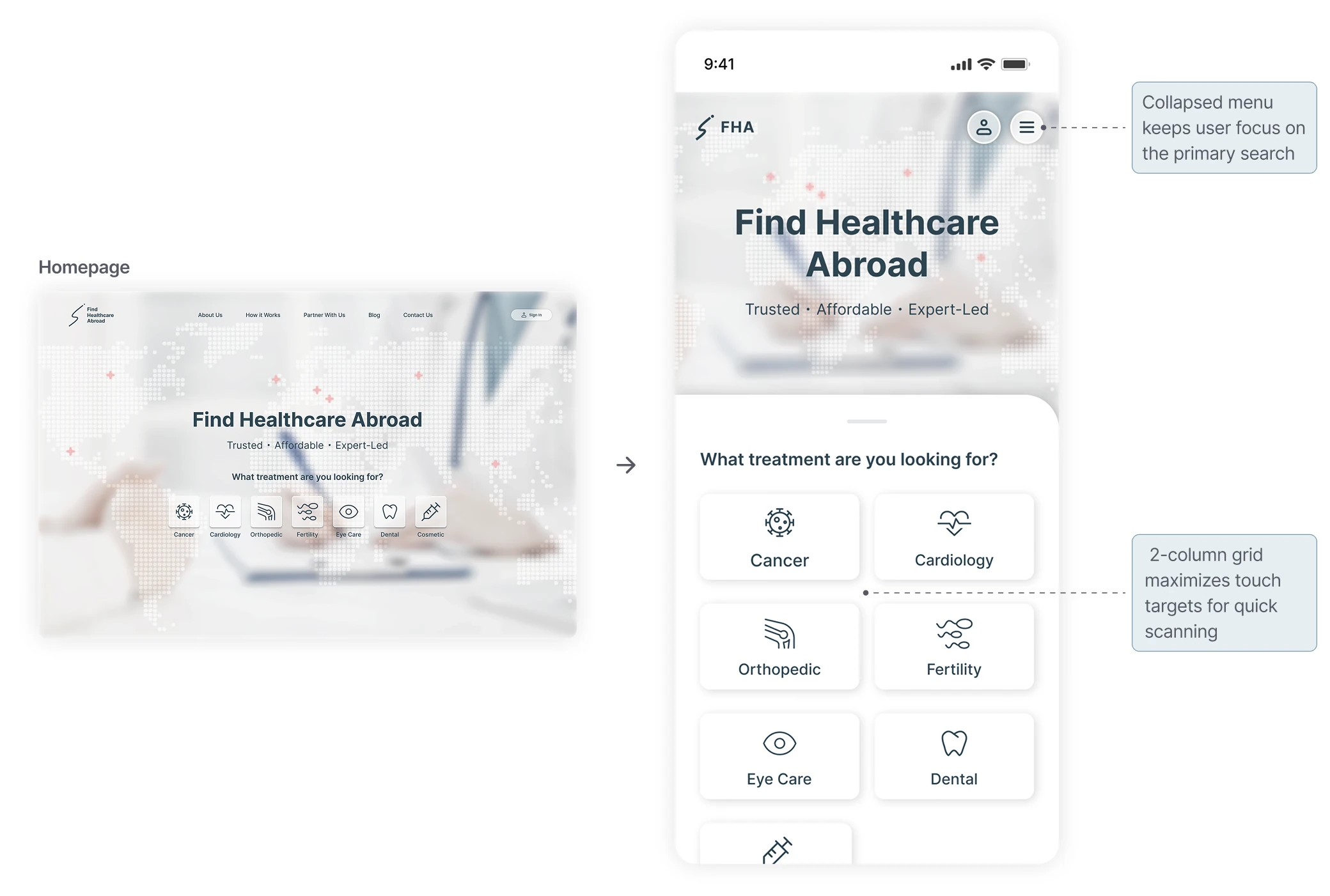
Eliminating broad search queries in favor of a category-first architecture. Guiding users by medical procedure reduces cognitive load and establishes a professional tone instantly.
-

Progressive Disclosure
Prioritizing human connection before complex details. Visual hierarchy establishes the individual expert first, only revealing treatment details and logistical costs once trust is secured.
-

Unbroken Reassurance
Resolving submission hesitation through absolute post action transparency. Frictionless forms and immediate confirmation feedback loops guarantee the user always knows what happens next.
The Solution
Building professional trust
The research findings shaped a clinical safety net where every interaction is a deliberate response to a specific user fear. By applying the three design pillars established in the strategy, the final interface prioritizes professional credibility and emotional safety within a medical travel context.
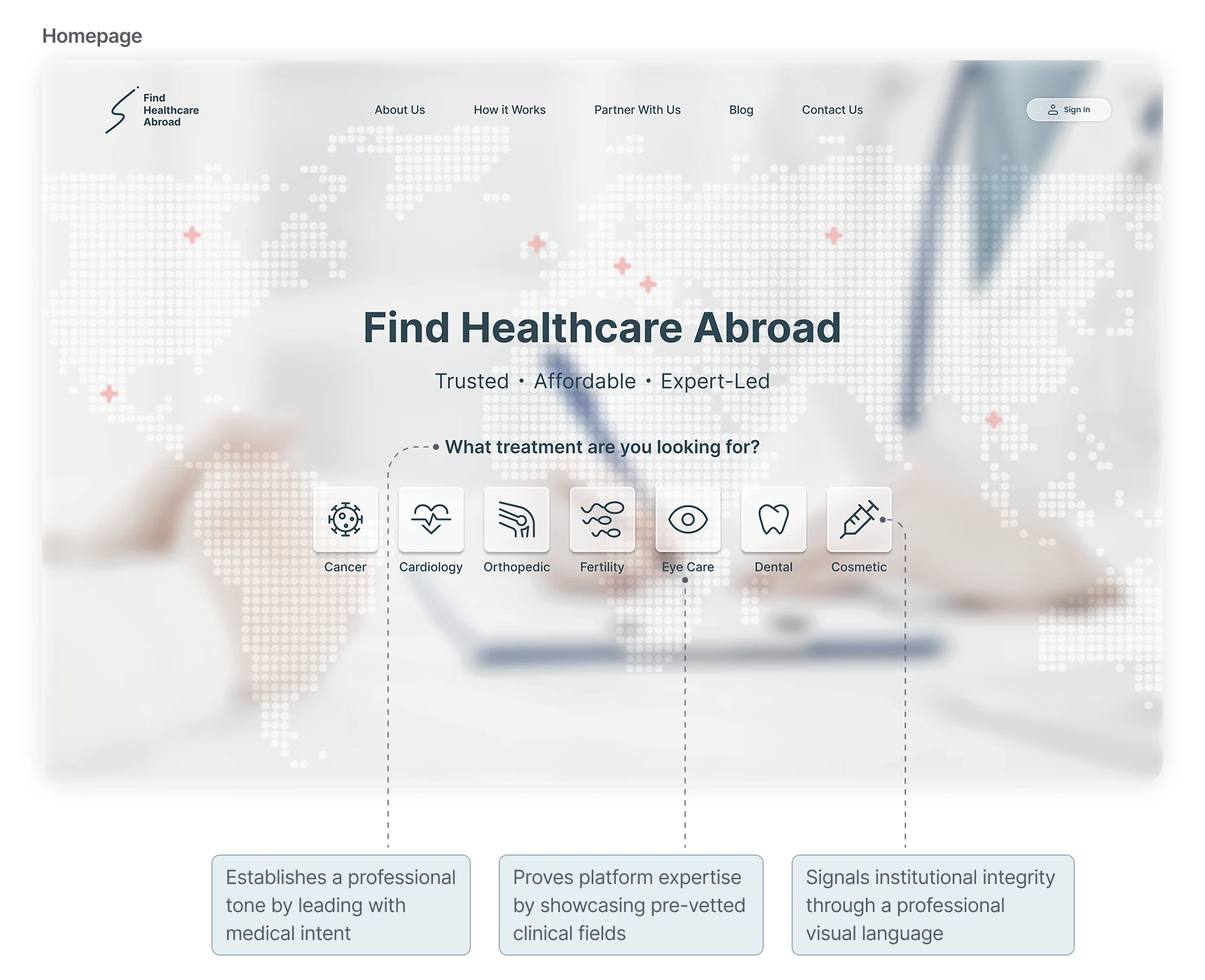
 Clinical Authority
A procedure-led entry establishes a professional tone and validates specific user health needs from the first interaction.
 Progressive Disclosure
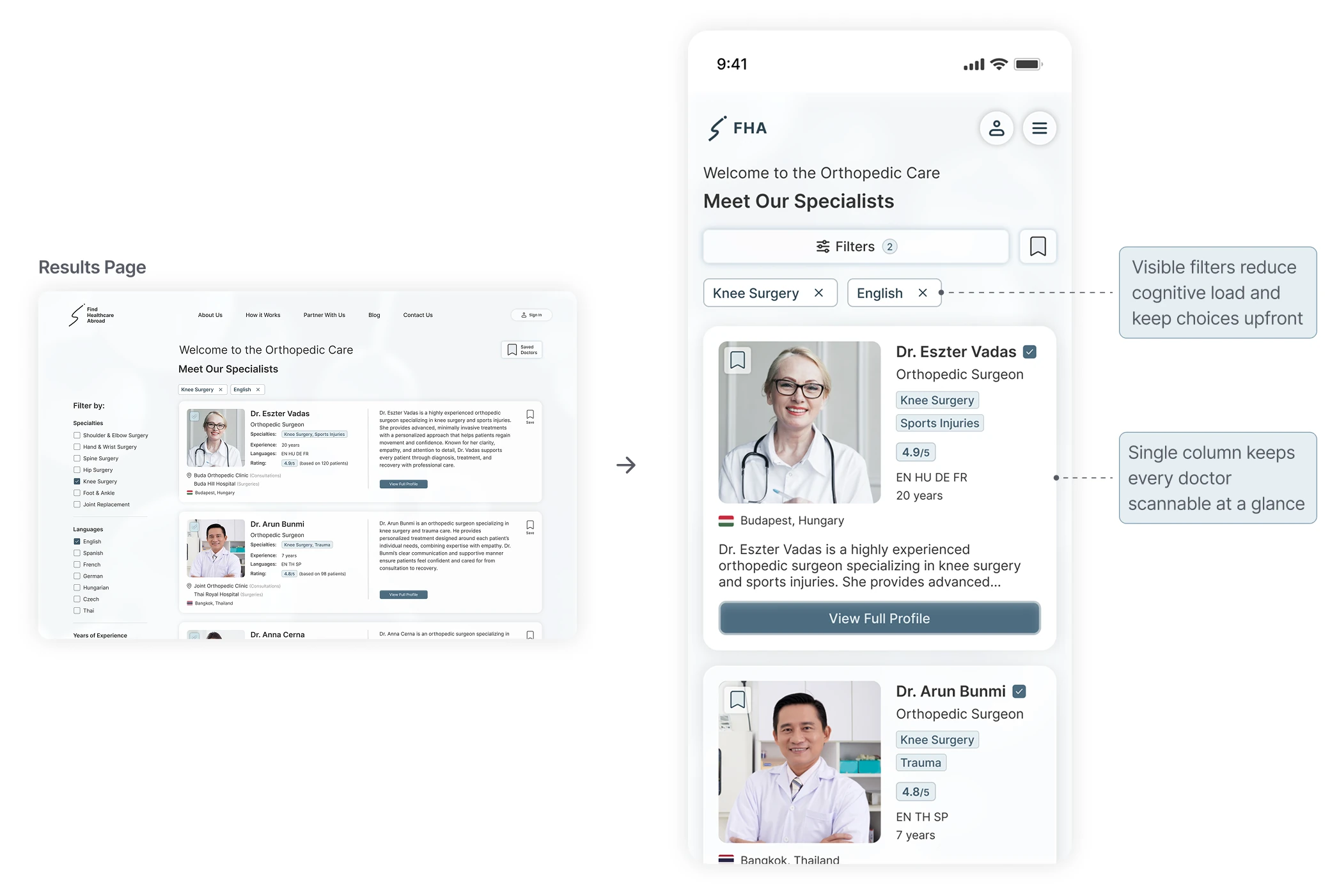
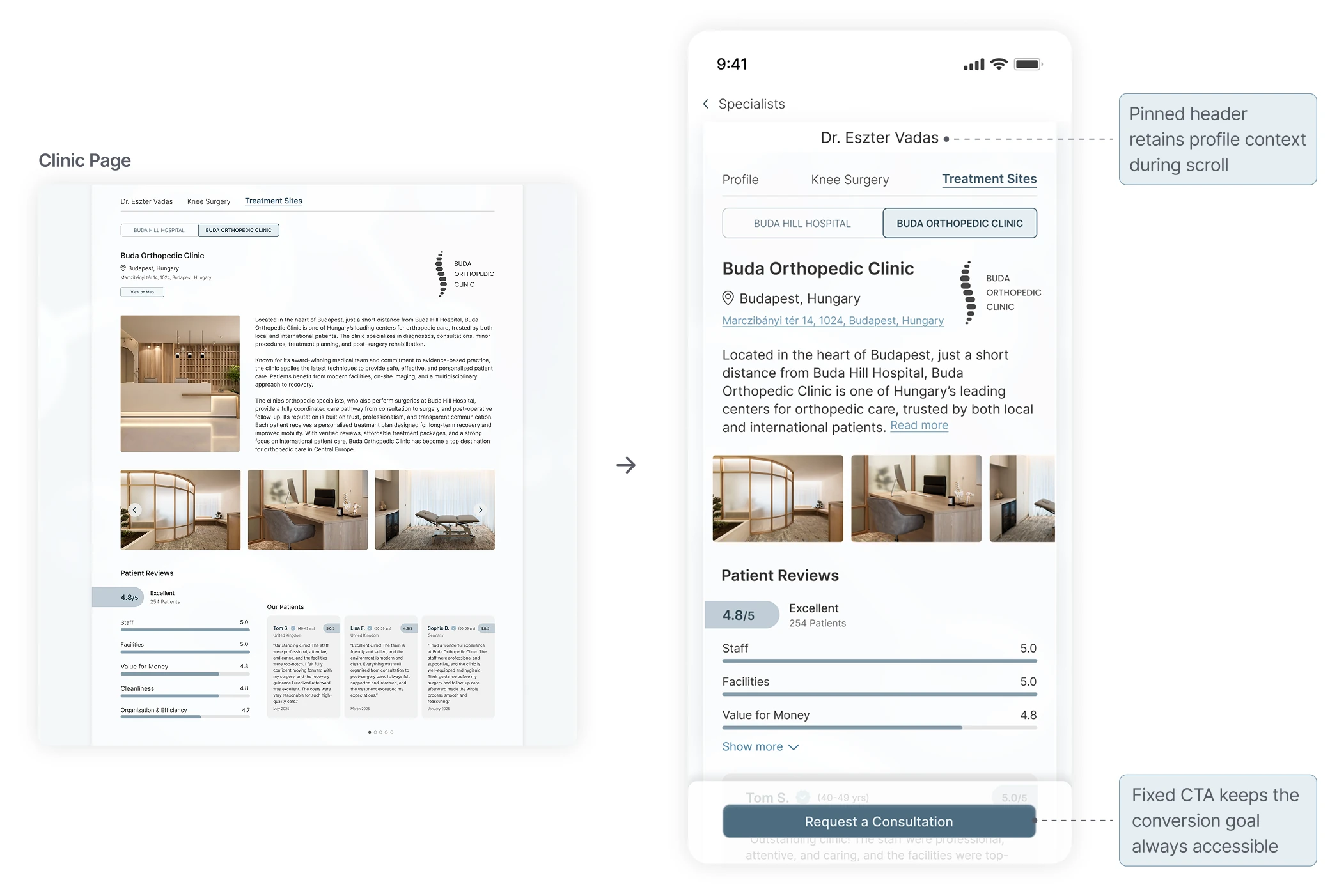
To manage complex medical data without overwhelming the user, the interface uses progressive disclosure, starting with highly scannable trust cards on the results page and leading into a comprehensive clinical profile.
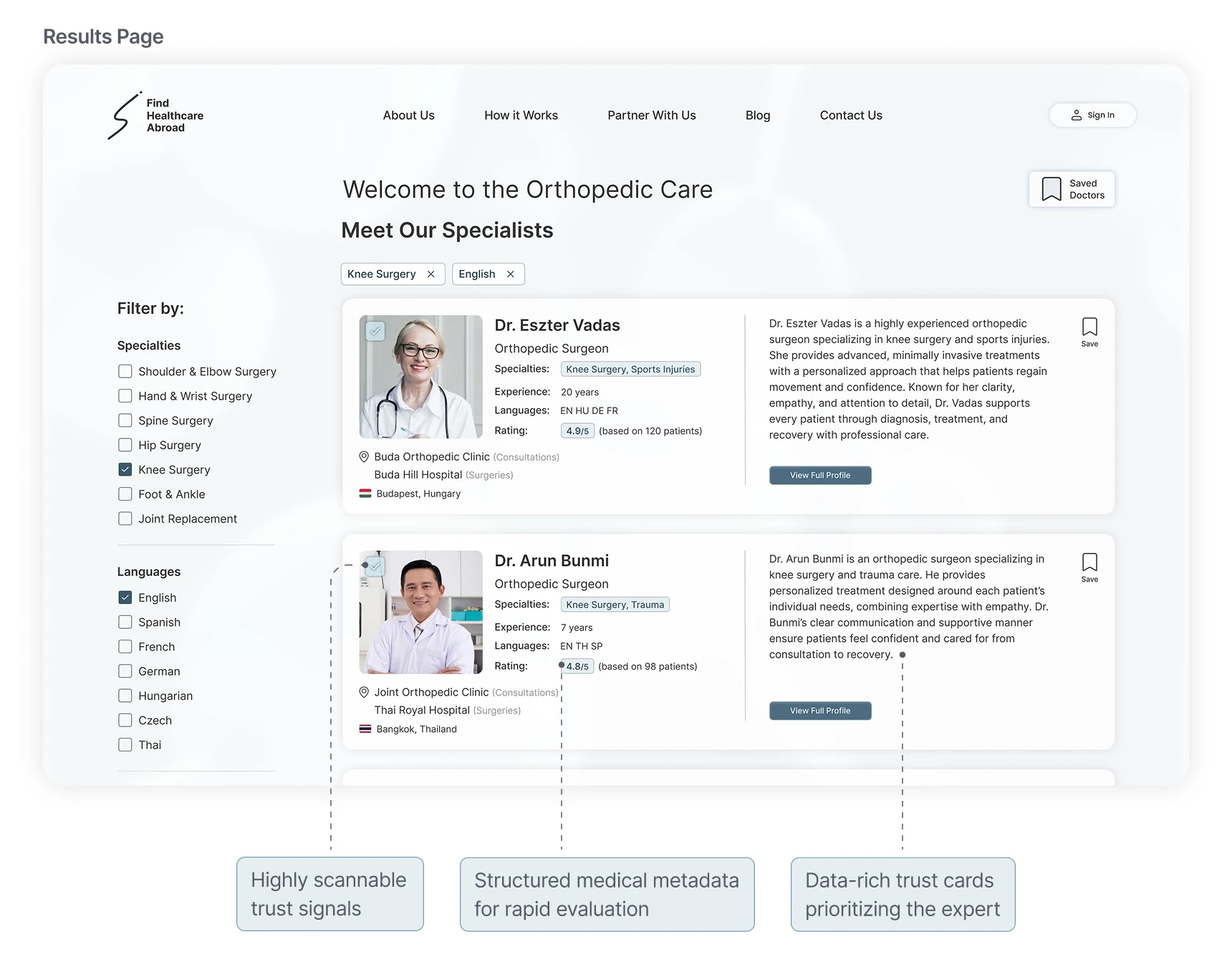
- 01. Expert centric hierarchy: Leads with verified photos and accreditation badges to establish immediate clinical authority.
- 02. Unified clinical unit: Uses tabbed navigation to connect the specialist, treatment, and facility into one cohesive view.
- 03. Intentional data pacing: Separates dense medical history from granular patient reviews to prevent cognitive overload.
 Unbroken Reassurance
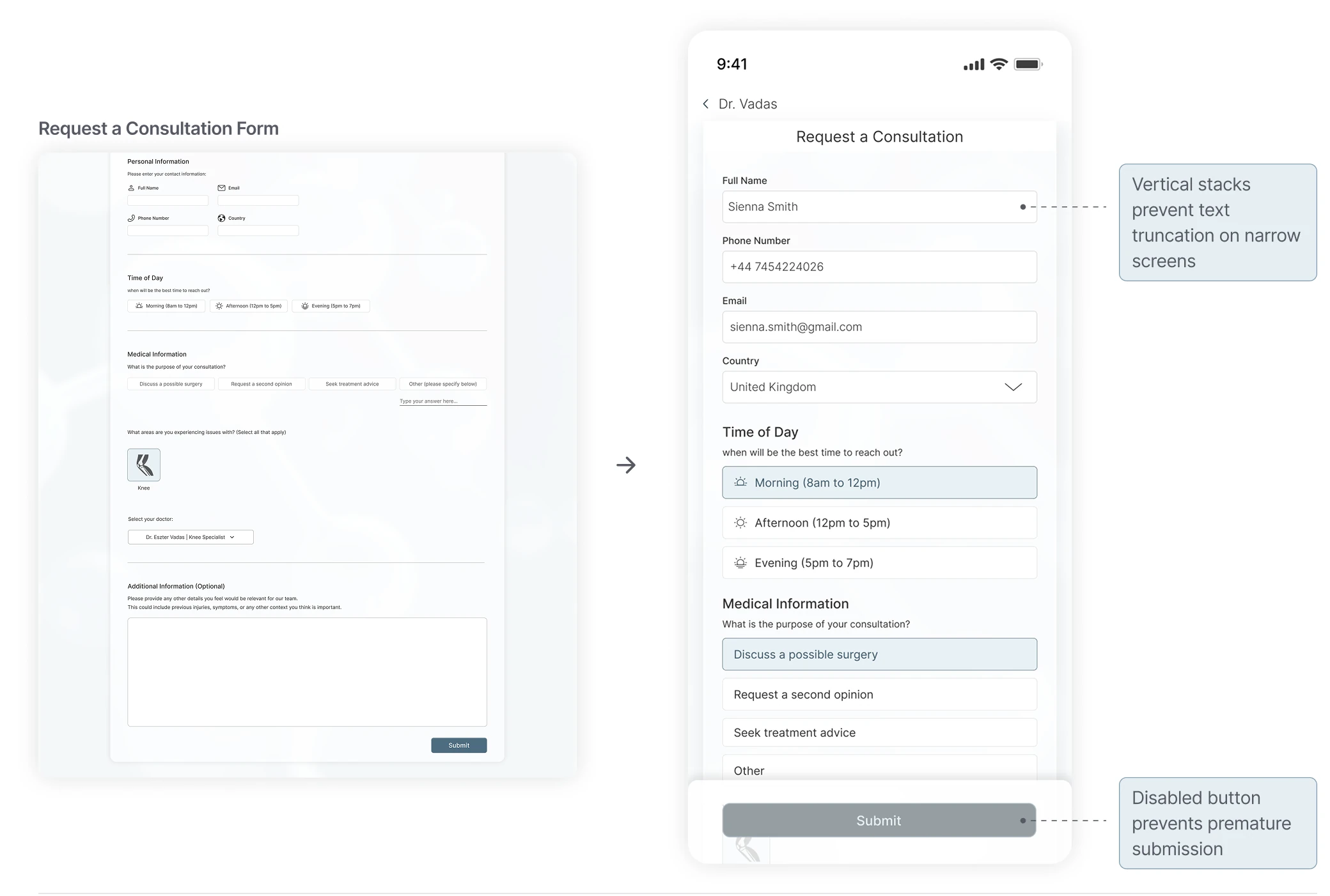
To ensure a smooth handoff after submission, the flow uses clear system feedback and exact timelines to build user confidence.
- 01. Focused clinical intake: Collects essential medical context without adding submission friction.
- 02. Predictable next steps: Provides an exact turnaround time and traceable case number on the confirmation screen.
- 03. Transparent contact channels: Reinforces reliability with direct access to human support and physical office hours.
Adapting for Mobile
Keeping the journey clear on a small screen
Measuring Success
Structuring trust in medical travel
This project proved that comprehensive transparency is the essential foundation for trust. To validate this strategy in a live environment, the immediate next steps would be tracking three primary success metrics:
-

Conversion & Lead Quality
Measuring consultation requests, and tracking how many inquiries result in completed medical treatments to evaluate true business impact.
-

Discovery Efficiency
Tracking how users interact with specialty filters and on card trust signals like experience and ratings to confidently select a specialist.
-

Support Friction
Tracking if the clear timelines on the confirmation screen successfully reduce the volume of anxious follow up messages.